Whot Hand Management: Track Shapes Without Guessing
Learn practical Whot hand management, how to track visible shape clues, and why a varied hand gives you more legal options.
Good Whot hand management means tracking visible information and keeping useful shape options in your hand. You do not need to memorise every card in the deck. Start with the active shape, the cards you can connect by number, and the actions that reveal what another player may not be able to play.
Last updated: 15 July 2026
The standard 54-card Whot deck
The standard Nigerian Whot pack has 54 cards. The five shapes do not contain the same number of cards, so it is better to understand the deck than to assume every shape is equally common.
| Card group | Cards |
|---|---|
| Circle | 12 |
| Triangle | 12 |
| Cross | 9 |
| Square | 9 |
| Star | 7 |
| Whot 20 | 5 |
| Total | 54 |
WhotGuide's teaching demo follows this 54-card structure. The exact special-card effects can still vary by table or app.
Keep options, not just a low card count
A beginner may see three cards of the same shape and try to play all of them as quickly as possible. That can work in a short sequence, but it can also leave the hand unable to respond when the shape changes.
A more useful question is: after this move, how many legal routes do I keep?
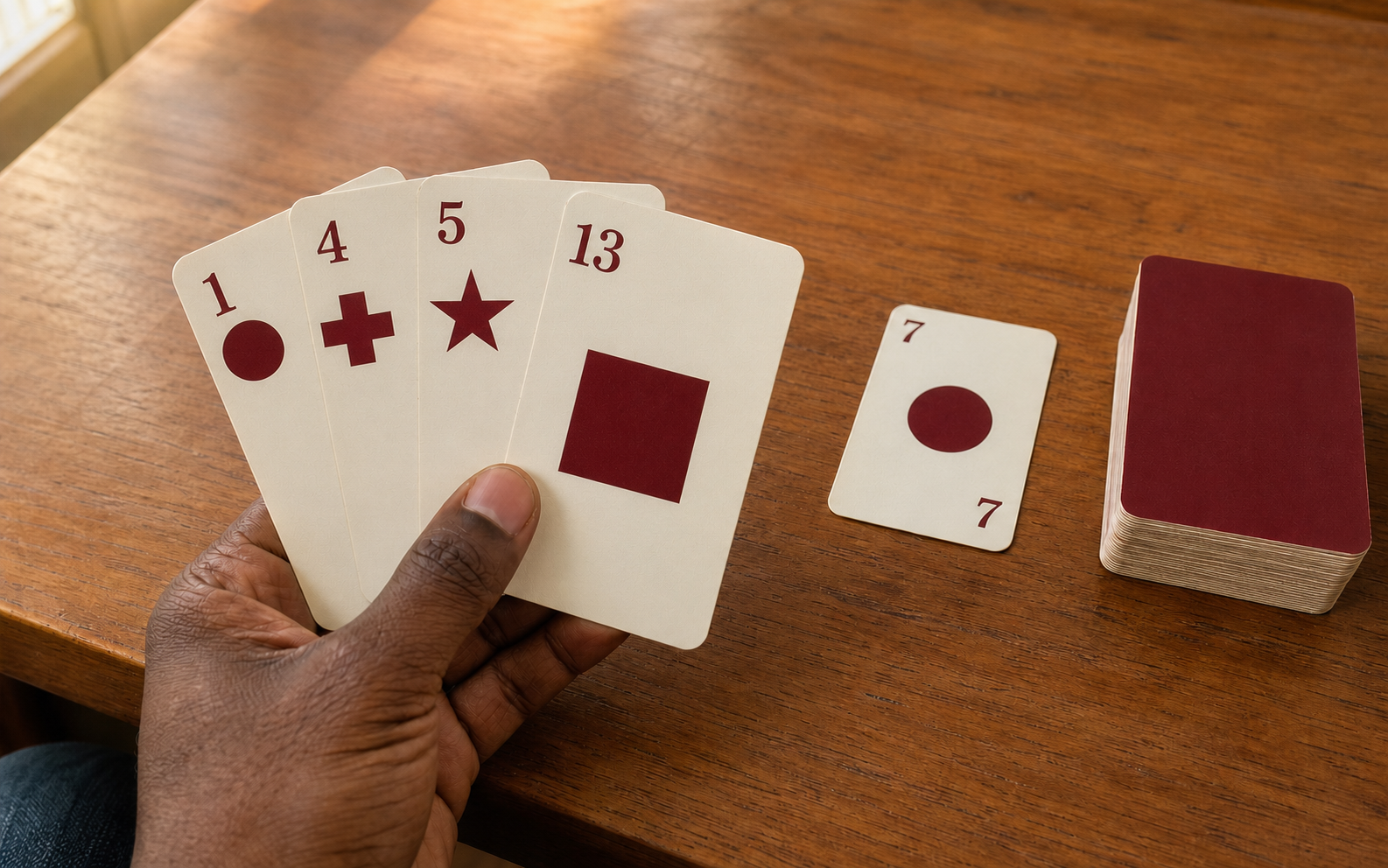
For example, a hand with Circle 1, Cross 4, Star 5, and Square 13 covers four different shapes. It does not guarantee a win, but it gives the player more possible responses if the table changes. Number matches can create another route because a card may be playable even when its shape is different.
Use market draws as evidence, not certainty
In the WhotGuide demo, a player draws from the market when they have no legal card. If Cross is active and the next player draws, that is a useful clue: they may have no Cross card and no matching number.
Do not treat that clue as a permanent fact. They may draw a useful card immediately, or another table may allow voluntary draws. Use the information to make a better next decision, not to assume you know every card in an opponent's hand.
A practical tracking routine
You do not need to count every unseen card. Track the moments that change the decision:
- Note the active shape and number.
- Notice which shape gives you the most follow-up cards.
- Watch for a market draw, a shape call, or a special card that changes the turn.
- Before playing, ask whether your move leaves another legal route.
- Reassess after every major action instead of following an old assumption.
This approach is more realistic than trying to memorise the whole pack during a casual game. It also works better when local special-card rules differ.
Avoid the common mistake
Do not force the table back to one shape just because you know an opponent struggled with it earlier. First make sure the shape also helps your own hand. The best strategic move is the one that improves your options while limiting theirs.
Read Whot rules for the basic turn flow, Whot special cards for rule variations, and Whot real game examples for practical decisions.