How Whot Scoring Works: Card Values and Points Explained
Learn how Whot scoring usually works, why card values matter, and how to reduce end-of-round penalty risk in Nigerian Whot games.
Whot scoring usually happens after one player finishes their hand. The other players count the value of cards left in their hands. Lower remaining value means a smaller loss. Because scoring rules can vary by table or app, players should agree on card values before the first round starts.
Last updated: 30 July 2026
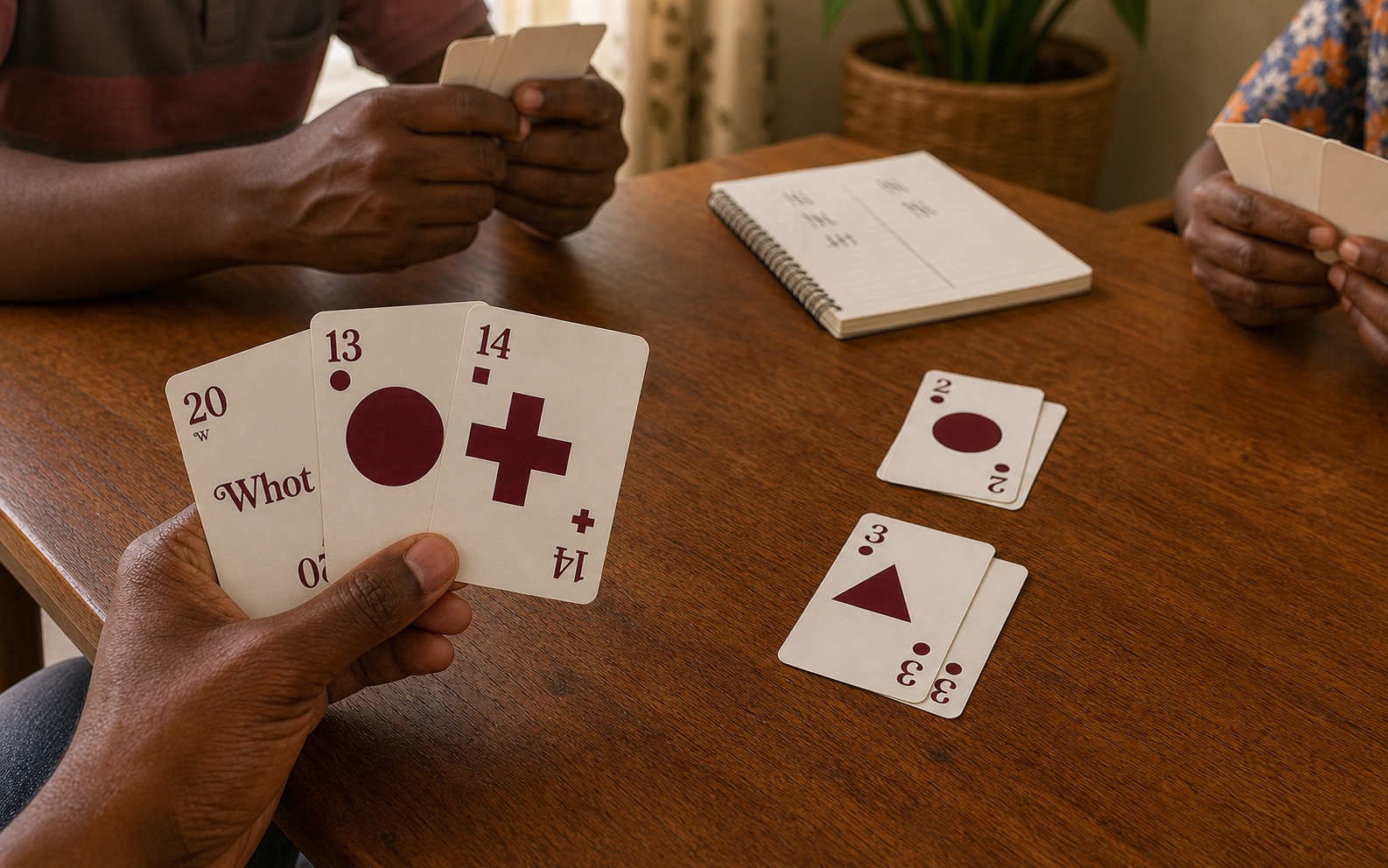
How scoring usually works
In many Whot games, a round ends when one player plays their final card. Every other player then counts the cards left in their hand. The player with no cards wins the round, while everyone else carries penalty points from cards they could not play.
That is why a player can lose one round but still stay strong across a longer game. Losing with only low-value cards left usually creates less score damage.
Whot scoring example
Whot scoring is usually based on cards remaining after one player finishes. Confirm the values before play because tables, families, and apps can use different scoring logic.
| Card type | Common scoring idea |
|---|---|
| Number cards | Often counted by card number |
| Whot 20 | Depends on table rules |
| Action cards | Depends on house rules |
Why card values matter
Every card you keep can become a penalty at the end of the round. At many tables, a 12 hurts more than a 3, and Whot 20 is one of the riskiest cards to hold late. The exact values can differ, so do not assume every table scores them the same way.
Confirm scoring before play. Do not assume every table scores Whot the same way.
The biggest beginner mistake
Beginners often hold Whot 20, high cards, or action cards too long while waiting for a perfect moment. Sometimes that works, but if another player suddenly finishes, those cards can become expensive.
If someone wins now, do I want to be holding this card?
When you should dump high cards
- Another player has called Last Card.
- You have no clear way to block the player close to finishing.
- Your hand is disconnected and hard to continue.
- You are holding several high cards with no useful route.
- The table is moving fast and you may not get many more turns.
This does not mean throwing away every strong card immediately. A powerful card can still save a round. When the round is slipping away, however, damage control becomes part of good Whot.
Example: losing small is still smart
Imagine two players lose the same round. Player A still has 20, 14, and 12 in hand. Player B has 2, 3, and 4. Both lost, but Player B protected their total score better.
Experienced players care about the cards left in their hand, not only the player who finished first.
Scoring changes your strategy
| Situation | Better decision |
|---|---|
| You are close to winning | Keep the route that lets you finish |
| Opponent is close to winning | Block them or reduce high cards |
| High cards have no follow-up | Drop them when legal |
| You hold Whot 20 late | Use it only if it can change the outcome |
| Scoring is unclear | Ask before the round starts |
Quick checklist
- How do we score number cards?
- How do we score Whot 20?
- Are action cards scored by face value or a table rule?
- Are we playing one round or adding scores across many rounds?
- What score ends the full game?
Key Takeaways
- Whot scoring usually depends on cards left after another player finishes.
- Number cards are often counted by number, while Whot 20 and action cards can vary by house rule.
- Good players reduce penalty risk when a round is slipping away.
Keep practising
Read Whot rules for the full round flow, then try Whot hand management to see how scoring affects real decisions.
FAQ
Does every Whot table use the same scoring?
No. Many tables use similar ideas, but exact card values and penalties can differ. Apps may also use their own scoring logic.
Is Whot 20 always the most expensive card?
It is usually one of the riskiest cards to keep at the end, but the exact value depends on the table or app rule set.
Should I always play high cards first?
Not always. If a high card gives you control, saving it can be useful. If the round is close to ending and you cannot win, reducing high cards becomes smarter.